
Writing is like...
Sale on synopsis reviews, OFIC Mag's relaunch, and 3 mini craft essays

Hello and happy summer, my beloved subscribers. You have not heard from me since January, and there’s a good reason for that: I’ve been working on the upcoming relaunch of OFIC Mag.
In this newsletter, I’ve got for you:
a breakdown of what the aforementioned relaunch entails;
a sale on synopsis reviews;
and a few mini essays made up of analogies of the creative process, ft. a very big blanket, roguelike video games, and Top Chef.
News & Announcements
OFIC Mag relaunches July 1
Since our initial launch in 2022, OFIC Mag has been a print publication. I’m very proud to say that was a successful endeavor. Unfortunately, practicalities got in the way, namely things like shipping, taxes, and physical space. With the addition of some minor irritations that started accumulating regarding a few of the services we used (coughSubmittablecough), we decided to go on hiatus until we could figure out a new approach.
Our new approach is thus:
We’re going to continue publishing a digital issue (EPUB/PDF) every April 1, July 1, and October 1, but instead of Patreon we’ll be using Substack to manage our subscriptions.
Free subscribers will receive one story every other week from either the most recent issue of OFIC or from our archives. Paid subscribers will receive the PDF and EPUB files of each issue as it comes out.
As we post stories from previous issues, we’ll link to them on our site in order to slowly build up an archive.
You can read more about OFIC on our About page.
We have some other stuff in the works too, but the overall gist of it is: one story in your inbox every other week. Easy peasy. If you want to get a jump on our relaunch, you can go ahead and subscribe.
Summer Synopsis Review Sale (20% off through July 31st)
A synopsis review is ideal for any of the following scenarios:
“I want feedback on a manuscript, but it’s really, really long.”
“I want feedback on my outline before I start writing.”
“I have an idea for a novel but I can’t make myself get started on it.”
A synopsis review addresses all three of these situations. Prior to the review, you’ll write a detailed (but casual) summary of a story, regardless of whether you’ve written the story itself or not. I then read that summary and we’ll meet over Zoom for an hour to discuss. Generally I come in with questions over criticisms, with the goal of working toward honing what you want the story to be and how you might best get there.
Synopsis reviews tend to be pretty popular because it’s a way for me to give developmental feedback without reading a whole book. I mean bigger than big picture—not just tightening up plot (although there is that), but addressing foundational “what even is this?” sorts of questions, which is great for either early drafting or approaching a major revision. Not to mention that sitting down and forcing yourself to articulate your story in summary is a great motivator in itself.
My favorite synopses are ones written in the voice of the author, with the formality of a tumblr shitpost. They can be up to 5k in length and have interjections like, “I don’t know what happens here,” as well as questions, outright explanations of character motivations, and open discussions of intentions. No need to allude or infer. The more I understand your interests and ideals, the more cohesive my feedback will be.
Use coupon code SYNREVCCP at checkout to receive 20% off through July 31st. You can book up to 3 months in advance of the call. That means if you book on July 30th, you can still get the coupon code even if you schedule the meeting for October. Email me at ekweeks@gmail.com or DM me on Discord (bettsfic) if you have any questions.
Writing is like…
Whenever I do something and it reminds me of my writing process, I go
So! Here are three analogies to the creative process that I’ve been mulling over for a long while.
…crocheting (or, Small-Picture Thinking)


I started this blanket in January, 2025, and finished it by Christmas. I’d recently picked up crocheting again after doing it off and on for 20+ years. The difference this time was that I was finally old enough to take it seriously. When I first saw the pattern for this blanket, I stared at the picture in awe, wondering how anyone could make such a thing, thinking I would never be able to do it. But I kept coming back to it until eventually I just bought it, and I bought the yarn to make it, and I started making it.
I knew it would take me a year or so, hundreds of hours, thousands of yards of yarn, but somehow I never doubted I would finish it, even though my entire crafting history of partially finished projects said otherwise.
I put about 20 hours into the blanket before I realized the colors were off and actually I hated it. A younger, less patient version of myself would have just given up, but instead I bought a color I liked better and started over. I would rip out dozens of hours worth of work if I found one mistake. I didn’t mind at all. A dozen hours isn’t much in the face of the many years I’ll own and use this blanket. My entire life, probably, and eventually someone else will inherit it. Maybe someone I’m related to, or a friend, or a random person who comes across it in a thrift store and wonders who would make such a thing. What I love most about crochet is that it’s one of the fiber arts that can’t be replicated by a machine. If you ever see a crocheted item, you know a human being made it by hand.
When I showed my mom the blanket, she said, awed, “I can’t imagine making anything so detailed.” (Kind of her to say, but she draws buildings for a living so that is absolutely untrue.) I told her, “It doesn’t seem detailed while you’re making it. You’re just working one stitch at a time.” In fact while I’m crocheting I lose track of the whole project. I learn the pattern of the next row and I do it. And then I move to the next and the next.
From a process perspective, writing a novel is very similar to the process of making this blanket. You have the bigger picture of the project that seems daunting at first and maybe psychs you out. Then you break it down into smaller parts, usually chapters. And chapters are just scenes, and scenes are just paragraphs, and paragraphs are just sentences, and sentences are just words.
Sometimes I work with writers who get so wigged out by writing that they use the bigger picture to distract themselves—giving themselves the task of making grand decisions that seem relevant and urgent but are actually just enabling their anxieties. How should I pitch this idea to agents? Who’s going to read this? What kind of writer am I? What genre should I write in? What should my pen name be? How do I develop an online following?
Those questions are kind of pointless, because the thing you’re writing—and the process of writing it—will answer all of them. The best thing to do when you’re fretting over “how can I do this?” is to write one sentence. Stop looking at the picture on the pattern and just start working it up.
…playing roguelikes (or, How I Learned to Stop Worrying and Love the Iterative Process)
A roguelike is a video game genre, usually in the form of a dungeon crawler—a series of randomized battles that take place in a labrynthian dungeon/tower/mineshaft/hedge maze/etc. As a reward for completing battles, you receive bonuses that will help you through the rest of your run. Usually you die and have to start over, but in dying you unlock permanent benefits that will help you in future runs. You might spend hours getting to the final boss, and the final boss might obliterate you, but in doing so you unlock new things like weapons, passive bonuses, health regen or revives, or in some cases you advance the greater narrative. And you do that about a million times until you reach the end of the story.
The namesake of the genre is a game called Rogue, an ASCII-based dungeon crawler from 1980. I haven’t played it, but I have played a number of others, my favorites being Hades and Hades II (Iliad/Odyssey-inspired dungeon crawler), Balatro (poker-esque card game), Slay the Spire (card-based dungeon crawler), PlateUp (restaurant simulator), Vampire Survivors (bullet hell), and Against the Storm (city builder).
Before I got into roguelikes, my roommate was convinced I wouldn’t like the genre. He thought I would get frustrated by any game where you go so far only to die and start over from the beginning. He must have forgotten that I have well over a thousand hours in Tetris, a game that by design cannot be won. My favorite thing in the world is doing something impossible a million goddamn times and watching myself get just a tiny bit better each time.
Like many endeavors, there are two ways to improve at a roguelike: skill and knowledge. For combat-based games, the skill is in the muscle memorization of the controller, balancing dodging and attacking to minimize the damage you receive and maximize the damage you inflict. But not all roguelikes have real-time combat, and for those that don’t, improvement is entirely knowledge-based. The more you learn about the game itself—the bonuses, combos, builds—the better you become at it.
Many people believe that to improve at writing, one must improve at the skill of sentence-making. This is true, much in the way that if you gain competency using a controller playing one game, you can use that same competency for another game. But I can’t apply much my knowledge of Slay the Spire to Against the Storm—they’re far too different. In writing, the more competency you build in sentence-making, the easier the process of drafting becomes, but the knowledge of the world you built in fantasy WIP A doesn’t much help you in realism WIP B.
What I’m saying is, in order to write the story you have to teach yourself the story. And to teach yourself the story you have to, you know, write the story. The worst ouroboros. First you have to learn the story (by writing it) in order to write it again, this time with more control over the narrative and the decisions, just like how in a roguelike you’ve only really begun the game once you’ve won it.
Because every attempt in a roguelike usually nets you something vital, the concept of losing is meaningless—it’s just one run among a dozen or a hundred or more. Similarly in writing, your first draft is just one among two or three or ten. Your first novel is just one among all the ideas you’ll have in your lifetime. The joy is in the iteration.
…cooking — and Top Chef (or, Validating Personal Tastes)
I’ve been watching Top Chef since it first started airing in 2006. It’s my ideal reality show: an elimination competition with a solid formula, interesting challenges, and contestants who are chosen for their skills rather than their capacity to incite drama. It’s one of the few reality TV shows that has integrity. (Don’t get me wrong—I still enjoy plenty of reality TV without integrity. But I appreciate Top Chef for being entertaining without engineering interpersonal conflict.)
For the past several seasons I’ve been thinking about how similar the world of fine dining seems to the world of literary fiction; culinary school and the MFA. The few plausible but practical jobs that follow: restaurateur, private chef; editor, teacher. And how at its core, both cooking and writing are foundational to being human. Sure, you can eat food without cooking it, and you can tell stories without writing them. But the practice of cooking and the practice of writing are the crafts of these basic features of living.
I’ve also become fascinated by the comparative, hierarchical attitudes toward both writing and food. For example, fast food and romance novels vs. fine dining and literature. And like nearly all MFA-educated writers, these chefs have the same inner turmoil: Do I share what I grew up with, what I love, but what is often looked down upon? Or do I use my knowledge and skills to step outside the box and create something no one has ever seen? It’s the forever battle of “fine” versus “authentic.” The answer always seems to be to try to find a balance.
Every episode of Top Chef is a lesson in process. The contestants have a very short span of time to take up a challenge, conceive a dish for it, and execute it. It’s like any other creative process, except a frantic trip to Whole Foods is involved. What results can be placed on a plane where the X axis is vision and the Y axis is execution.
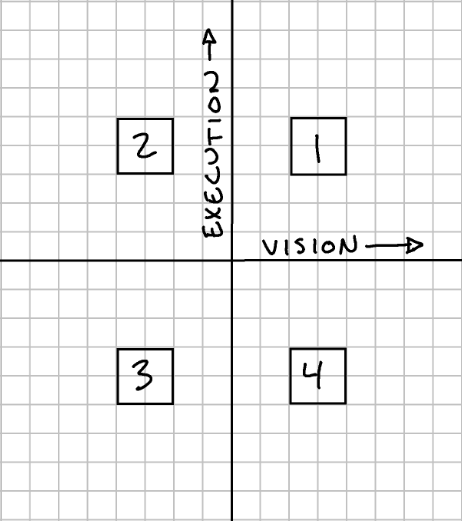
The quadrants are:
The chef has a clear vision for their dish and executes it well. These tend to be winning dishes.
The chef has no real vision for the dish but they manage to pull it off—this puts them in the middle or top.
The chef has no real vision for the dish and it never comes together—generally this gets them kicked off depending on how many others also find themselves in this quadrant.
The chef has a clear vision for their dish but executes it poorly—depending on how well others do, this could put them in the middle or at the bottom.
What I find interesting is that just about every chef knows how they did before judging, even if they say otherwise. Being at the top or bottom is never a huge surprise, just a relief or a disappointment, respectively. Of course, in any standard distribution there are a handful of chefs who always doubt themselves and think they’re worse than they are, and a handful of chefs who think they nailed it when actually they’re just okay.
As a writing coach, I see this often. A majority of writers I’ve worked with are excellent at assessing their own work and skill, but like the chefs, for some reason the thing they’re doubtful of is their ability to self-assess. Before I give my feedback on a work, I always ask, “How do you feel about it?” and what they tell me tends to be a more general version of what I’m about to tell them—they sense something is off but they can’t exactly pinpoint it or solve it. The same goes for the chefs. They have a sense when something is off but don’t know for certain until the judges point it out to them.
I’ve been watching Top Chef far longer than I’ve been cooking for myself. I’ve only recently learned to cook, by which I mean I no longer rely on recipes. I’ve always dreamed of being the sort of person who can look in a fridge and throw something together, and over the past few years I’ve gotten pretty good at that. I now cook food I like to eat more than getting takeout.
What stopped me from learning to cook for so long was the belief that the food I made had to be good. Not just tasty to me personally, but objectively Good and made Correctly.
But then I started teaching myself how to cook the way I taught myself how to write. My big writing epiphany: writing can be fun if I always write what I want to read. My big cooking epiphany: cooking can be fun if I always cook what I want to eat. In the same way the world of creative writing opened to me when I realized I could put smut in everything, the world of cooking opened to me when I realized I could put cheese on everything.
In retrospect, it amazes me how misaligned we become in early adulthood. In adolescence you learn who you are and what you’re about, and then somehow you become convinced that you’re wrong, and you journey to become something you’re not. We habitually invalidate our own tastes. If we like it, we think there must be something wrong with it. If it’s too easy to do, it’s bad. If it’s too fun, it’s bad. Good things require discomfort, displeasure, and an arduous process to understand and accommodate that which is opposite from you, which is seen as inherently better because it is opposite from you.
The chefs that get far in Top Chef are the ones who learn to trust that they know what’s best for their food, that their culture, history, and tastes are what people enjoy eating and what they enjoy cooking. Similarly, the writers who get published are the ones who habitually validate their own tastes and learn to be confident in what they love.
"What I’m saying is, in order to write the story you have to teach yourself the story. And to teach yourself the story you have to, you know, write the story." [burns this into my heart]
So much respect for OFIC. May the summer bring blessings to all of us!