
[august 2025] 36 writing tips, tricks, and truisms
or: my 36th birthday, a proclamation of my love for Rodion Romanovich Raskolnikov, and (finally) all my writing advice tidbits in one place

last week i turned 36! i had a great birthday—my local theater was playing a special screening of Roman Holiday and i went to see it with my family. the theater was completely packed. halfway through the film my grandmother said, very loudly, “WAIT, is that Gregory Peck??”
she also asked why the Colosseum is “all torn up like that” and pointed out—reasonably, i think—that if only her highness’s servants had “one of those porch camera things” they’d know where she escaped off to.
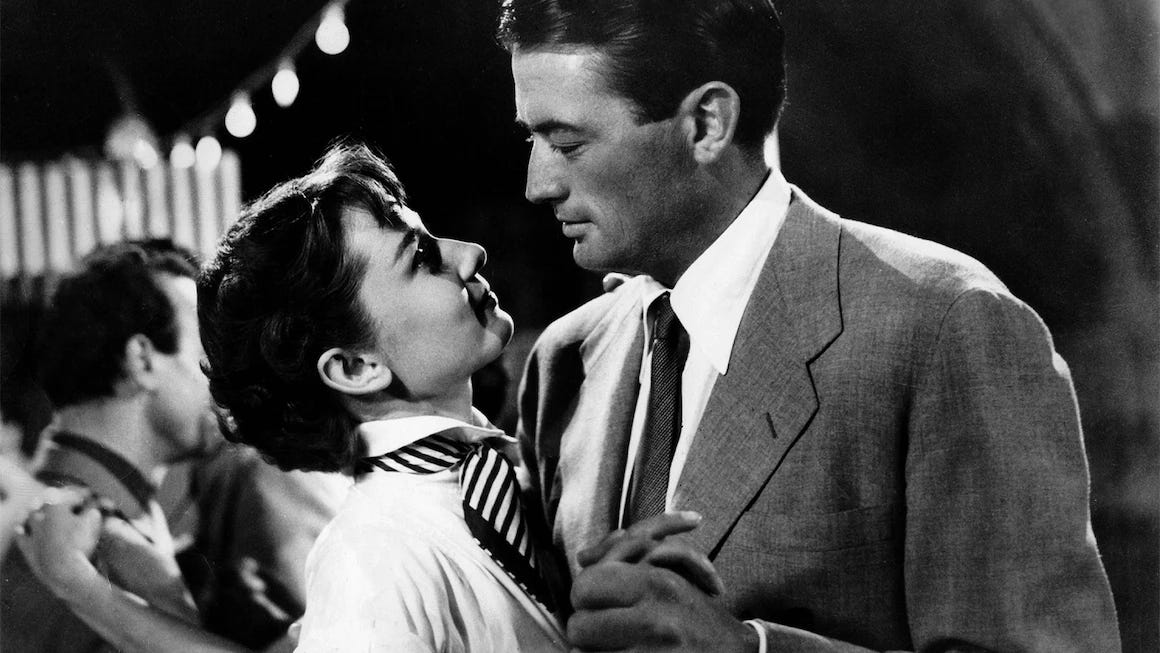
being as i am an ace-maybe-aro who still does not understand why Pride & Prejudice is romantic, i was surprised by the fluttery fangirl feelings Roman Holiday gave me. i’d seen it before when i was a kid but as an adult it hit me like a bus. or more aptly, a poorly driven vespa. it’s that very unique combination of “this is a perfect thing and i admire it so much” and “it ripped my heart out through throat and i respect the ending but i cannot accept it” that tends to burrow into my psyche and infest it until i Write A Thing. several Yuletide writers of yore have provided loving and brilliant fix-its, but none of them have exactly hit the spot.
what if.. i were to..
write Princess Ann/Joe Bradley fanfiction..
and disguise it..
as an original story..
haha just kidding…
unless?
BUT FIRST, some announcements.
last day to submit to OFIC Mag Issue #13—our FINAL print issue!
despite a successful run as a physical lit mag, we’ll be moving fully digital in 2026. so if you want to see your work in print, be sure to submit to lucky issue #13! we’re looking for original short stories and essays from writers in fandom. max word count is 15k. content-wise, feel free to surprise us, thrill us, disgust us—anything goes.
OFIC Mag Issue #12 is out now
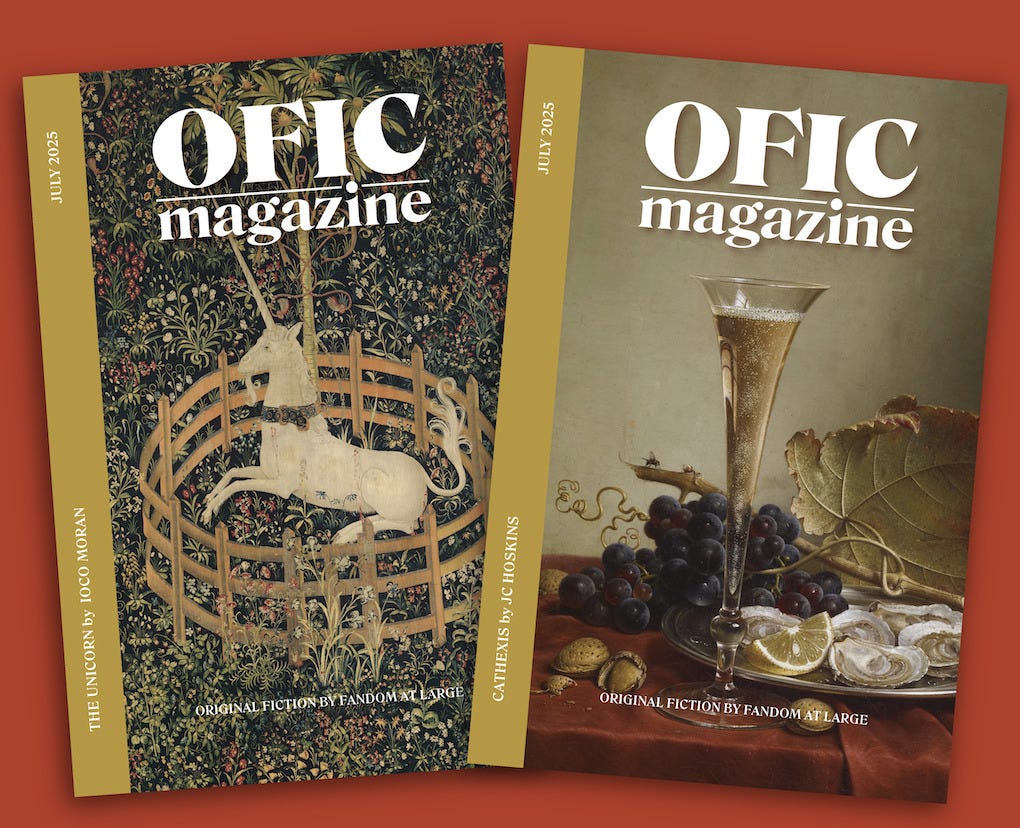
Summer is here and that means we've chosen two phenomenal novellas to share with you in our second "Doubles Issue." These novellas speak to each other in such unique ways. One is set in '90s USA and the other in '20s England (that's 1920s). One involves poison and the other possession. One is realistic and the other fantastical. Despite these differences, both unfold through the slow reveal of close-kept secrets.
In Unicorn, a teenage girl dreams of poisoning her abusive mother. Meanwhile, she fosters a crush on the town drug dealer, who may or may not be keeping a big secret from her.
In Cathexis, a demon prince bored with his tyrannical reign is presented with a young man possessing a secret the prince can't crack, and embarks upon an unorthodox method of interrogation.
for real, this is one of my favorite issues we’ve ever put out. i’m so grateful to our contributors Ioco and JC for trusting us with their phenomenal work.
we have a limited supply of physical copies, so if you want this gorgeous duo in your hands, be sure to buy one soon!
Fanauthor Workshop, Fall 2025 applications open until Sep. 2
Where & When
We meet weekly over Zoom. You can apply for one of two sessions:
Group A: Thursdays from Oct 2 - Nov 13, 12-2pm ET [See what time that is in your time zone]
Group B: Mondays from Oct 6 - Nov 17, 6-8pm ET [See what time that is in your time zone]
Note that USA daylight savings begins November 2nd. For those outside the US, our sessions will move one hour back.
What
FAW is a feedback-oriented workshop. This means that each week we read 2 pieces submitted by participants, offer written feedback, and discuss them over Zoom. You'll be able to sign up for the week you would like to workshop your own piece, which can be anything under 6k words.
There may be weeks where, in lieu of workshopping, I present external readings and writing exercises.
I developed a workshop model that focuses mostly on affirmations and positivity, as well as descriptive over prescriptive feedback, which is to say, describing one's experience of reading rather than prescribing solutions to perceived problems. We also present improvement-oriented feedback, but avoid negativity, judgment, and pedantry. Week 1 is spent going over the workshop model and how to give feedback.
the FAW community has become even more active this year. in addition to things like an active server, weekly accountability meetings, sprints, and quarterly tracking, we now have:
music league,
sunday movie nights,
powerpoint parties, and
The Tree
we water a, uh. tree. in discord. it’s in space now, i don’t know. but we are all very serious about it.
to learn more about applying to FAW, check out the tumblr post (and share with your fan-oriented writer friends?)
what’s happening on the sidestack
over on my Unhinged Morning Pages, i’ve posted...
my annual solstice essay

part 2 of Coping Skills
and a breakdown of chapters 1 through 4 of How to Write a Sentence
coming up, we have my end of 2024 writing logs, parts 3 and 4 of Coping Skills, more CEADs, and a special series where i pull the most salient quotes from the Paris Review’s famous Writers at Work series and offer some commentary.
full access to Unhinged Morning Pages is $7/month or $70/year.
a change in schedule
on a personal note, i’ve been having some health issues and so i’m changing my coaching/consulting schedule. whereas before, all calls were Tuesday/Thursday, i now have shorter appointment periods Monday through Thursday.
M/W: 3-5pm ET
T/Th: 12-2pm and 6-8pm ET
i can make exceptions as needed. also i’ll be on vacation from the end of September to early October.
what i’ve been into lately
Crime and Punishment (Dostoevsky, 1866)
a million people can say “hey this is the best novel ever written” and you might not want to believe them out of a sense of spite and contrariness, but goddamn. this is literally the best novel i’ve ever read. and i am not being hyperbolic. if you’re looking for an in-depth character study of a man who, in another time, would have been a problematic tumblr sexyman and/or babygirl—also, murderous grouch to his codependent sunshine best friend—this is the book for you.
actual plot:
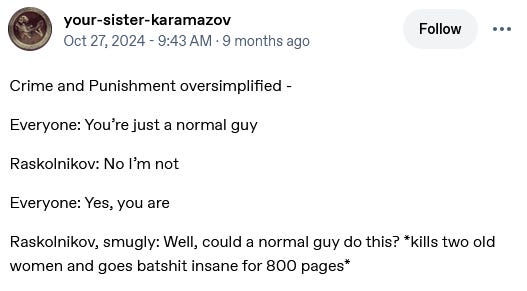
other memes of note:
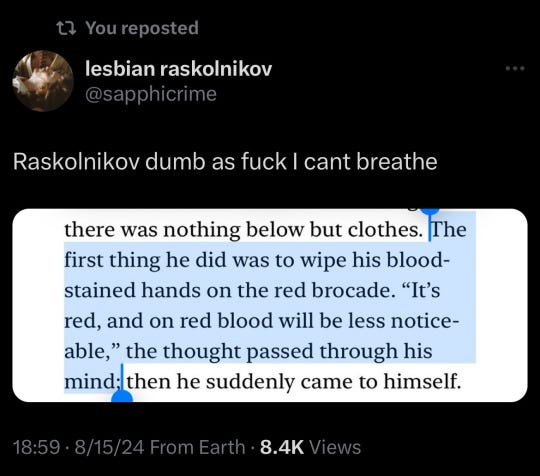
Raskolnikov is truly the cringefail loser of all time.
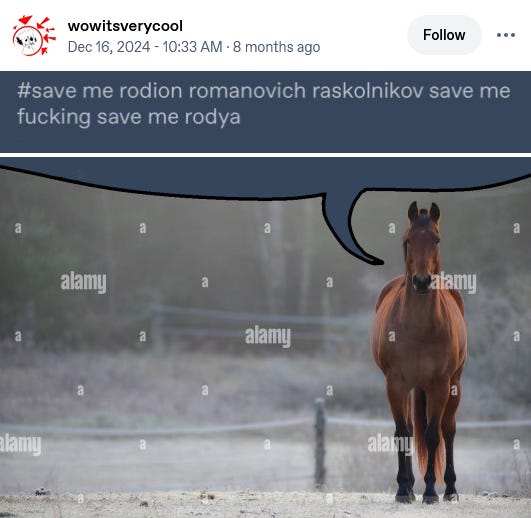
this is the funniest post on the entire internet.
is C&P long? absurdly. is it boring? absolutely. is it nearly impossible to keep track of the dozen characters who all have three names each? you bet. should you read it? yeah.
especially if you, like me, are ben-affleck-smoking-a-cigarette.jpg jaded by mediocre contemporary tradpub and find that you’re willing to plumb the dangerous depths of overhyped classic literature that may or may not have been on the comps list of the PhD you (i) dropped out of—oh boy is this book a delight.
36 tips, tricks, and truisms about writing
three years ago i wrote a post of 33 hard-won things i’d learned about life and it went semi-viral, or as we like to say on tumblr, broke containment. i’d been meaning to do another one specifically about writing and so i’ve spent the past several months collecting all the little craft ideas i share with fellow writers.
i hope you find it helpful or at least illuminating, but if you feel it deters you, remember: #36 is what matters most.
process
writing is the process of thought, not the product of thought.
process-based writing pedagogy is founded on the idea that we write to think, not as the result of thought. that’s why the shitty first draft is so important—you have to think out all your thoughts on the page before you can truly begin to make sense of them. or, in the words of Robert Pinsky relayed to me by my friend Sam, the order of composition is not the order of presentation.try not to say no while drafting.
it seems like dismissing ideas for “stupid” story threads/beats will save time, but in the long run it saves more time to see them through (“yes, and” them) and be willing to cut them later if they don’t work out. sometimes in being self-dismissive, we end up wasting more time than if we just entertained our “bad” ideas to figure out what they’re really trying to tell us.internalize the rewrite.
some writers are horrified by the idea of a complete rewrite. it seems like yet another waste of time. you already wrote the thing, why would you rewrite the thing? but if you tell yourself, “it doesn’t matter, i’m going to rewrite it anyway,” you end up writing way faster (and sloppier!) and getting more ideas (and having fun!) on the page than if you try to get it right the first time.“writing” is not just writing.
for some reason we’ve chosen the word “writing” to encompass about 70 different things. writing means drafting, but also the act of writing by hand, but also typing, but also—and this is what baffles me the most—it has a connotation of productivity. by (the physical act of) writing, we believe we make progress. and so when we’re not writing, we can get it in our heads that we’re not doing anything. i am here to tell you that brainstorming is writing, outlining is writing, making aesthetics and playlists inspired by your story is writing, talking about your story is writing, and most importantly thinking about your story is writing. the process of fully conceiving an idea for a story can take ten times longer than writing the story itself. just because you don’t put words on a page doesn’t mean you didn’t do anything.find a place to put small things.
you probably keep your documents in nested folders, or if you write by hand, in notebooks. but you also need designated places—even if only conceptual—for other aspects of writing. you write more if you know where that writing belongs. for the longest time i didn’t have anywhere to put things that were smaller than story ideas—like relationship dynamics, specific images, etc.—so i just lost them. and then i started using a notebook specifically to put down all my fractions of thoughts and now nothing is lost. conversely, while actively writing a story, you need a place for things like scene ideas, brainstorming, scratch-pad writing, and so on. it’s a good idea to carve out those places in advance as part of your (pre-)writing process.
activities
reverse outline your favorite things to learn structure.
k-dramas are often in a 10-episode structure, where the same basic plot movements happen during certain episodes no matter what the story is. there’s usually an early romantic moment in episode 4. by the end of episode 6, we can start to see the endgame. episode 8 is always the lowest emotional point before the protagonist picks themselves up and fixes everything. it’s a formula, sure, but it’s such an effective formula that thousands of types of stories can fit into it. especially if you’re struggling to figure out what happens in a WIP, reverse outlining your favorite stories—summarizing the major plot beats and turning points—can really help you see the shape of them. then you can cookie-cutter that bitch into your own proverbial cookie dough.transcribe real dialogue to learn voice.
one time i transcribed a conversation i had with my grandma and i was stunned to notice the difference in our syntax. that made me realize that our actual voices and the way we speak can be rendered on the page by means of memorizing the stylistic and syntactic moves of speech. where are the interjections? the repetitions? the tics and turns of phrase? like acting, you can start to internalize those so they come out onto the page more easily.“the interrogation room” (a practice in writing first person POV)
the key to good first person prose is not simply swap out “he/she/they” for “i” in your natural writing style. to write in first person is to write a monologue. the activity is this: take your main character and put them in an interrogation room. imagine yourself standing across from them and demand that they tell you their story. you may find that they’re trying to persuade you of something, or they’re confessing something that’s been weighing on them, or they’re straight-up lying to you. transcribe the story they tell you.use anaphora as a warm-up exercise.
this exercise is fantastic for the type of writer who says, “i’m fine once i get started, but it’s really hard to get started.” try this: take your main character and begin a sentence with “i want” (or “she wants”—whatever POV you’re using). don’t think too hard about it. now start the next sentence with “i want.” and the next and the next. set a timer for 5-7 minutes and write as many “i want” sentences as you can. this probably won’t make it into the final draft, but it’s a fantastic practice in understanding character and motivation. substitute “i want” with things like “i love” or “i hate” or “i wish i’d never” to change up the exercise.try single-element imitation.
another deceptively simple but effective exercise is to pick up one of your favorite books or stories (or better yet, maybe one you absolutely despise). read a section of it. notice something, anything about it—the setting, style, tense, person, paragraphing, anything that seems unique to that author or work. then write a paragraph or two—or a section of WIP, or a whole story—experimenting with the thing you noticed. imitation and experimentation are both necessary in developing your writing skills, and this is a very efficient and intentional way to do that.
craft
the height of your stakes determines the length of your story.
kind of like a right triangle. consider what’s at stake for your main character and how much work it will take to reach a resolution. a character whose stakes are very high will take them much longer to see their story fulfilled. stakes, of course, are relative. depending on the writing style, a character retrieving a can of Diet Coke from the fridge might have higher stakes than one who’s cheating death.the definition of conflict is to establish a status quo and upend it.
stories begin in a state of harmony, even if only briefly. this is called the exposition. then the inciting incident comes and disrupts that harmony. your conflict is the means of restoring peace in your character’s life, no matter if that peace is happy (getting what they want), bittersweet (getting what they want but there are consequences), or tragic (failure or death).consider making your climax your inciting incident.
this is more of a thought exercise than a suggestion. often when i read a synopsis, there’s a big ramp-up and the story ends on a suspensful note where the main character is about to enter into an even greater adventure. writers never like to hear that their entire book is actually the backstory of a different book, so i think it’s a good idea to take your story idea and figure out if it’s ending at Game Over or Level Up. if you find your story doesn’t actually end with a resolution, pretend the end of your story is actually the beginning of it and jot some notes about what happens next.
structure is the way a story is organized.
it took me a looooong time to appreciate (and understand) story structure. most of the time it’s something a reader doesn’t really notice, because a majority of stories are chronological—organized by time. a thing happens, and another and another. but you can also organize your stories in different ways. a great example is the classic 5+1 fanfiction structure. my personal favorite structure is informational. in other words, organizing a story by the importance of each reveal, which develops a different kind of meaning and suspense than chronology alone can provide.
your narrator creates psychic distance.
in The Art of Fiction, John Gardner defines psychic distance as “the distance that the reader feels between himself and the events of the story.” (i’ll be doing a CEAD series on The Art of Fiction soon.) your narrator determines that distance. a first-person narrator might be so close to the reader and wrapped up in their thoughts that we struggle to understand the external events of the story. conversely, a third-person heterodiagetic narrator (one who is not a character in the story, like in fairy tales for example) would have significant distance, perhaps denying us any interiority at all.
reading
never be afraid to read.
it is a natural instinct to want to avoid certain books for whatever writerly reason: it’s too much in your wheelhouse, or you’re worried you’ll accidentally plagiarize or maybe take on a different style. and maybe that’s a little bit true, but what’s more often true is that you’re afraid certain books will make you insecure. especially if you intend to publish, it’s better to read your contemporaries and know what’s out there than to ignore them because you want to be totally original. these are writers who are going to become your peers and friends once you put your story into the world, so it’s a good idea to be familiar with their work. personally i think it’s always better to know than not know.
if your TBR is too long, get picky.
a few years ago i told myself that i would put down any novel that doesn’t offer me at least one of two things: insight or entertainment. in other words, if i feel a book is not teaching me anything relevant to my own work and it’s also not keeping me entertained, i put it down at 10%. a 300-page book has 30 pages to get me invested. i found that i read SO much more now and it’s SO much easier to keep my to-read list manageable. it’s brutal, but there are a million books in the world and you only have one lifetime in which to read them.
your tastes probably won’t change.
in developing a writing expertise, the list of things you love will only get longer, not shorter. you’ll end up refining what you already admire by positioning it against what you don’t. improving as a writer is in some ways a constant exercise in validating your own tastes.annotate your books.
i have no idea why this is so divisive. a book is not a sacred object; it’s a thing you own. you have a right to mark it up for your own benefit, especially if you’re reading as a writer. i can’t tell you how much more i get from a book that i annotate than one i don’t. it gives you the opportunity to talk back to the story and therefore engages you more deeply into it. think of it like this: one day you become ultra super mega famous and your entire book collection goes to auction. how much more valuable does each book become when your notes are in it?
try different reading styles.
if you’re a native English speaker, or a speaker of any phonetic language, you probably learned to read by sounding out letters, hearing yourself speak the word, and then connecting that word to what you know it means. if you “hear” words in your head as you read, you’re subvocalizing. subvocalized reading takes much longer than the opposite—identifying words by their shape, or recognizing words as characters. i’m a subvocal reader, relatively slow for a writer, but i also have high comprehension and i find i don’t often re-read books because my memory of them is so strong. however, in grad school i taught myself how to read without subvocalizing. skimming is fastest—i’m looking for specific things and not taking in the rest. speed-reading is when i’m only looking at the center of each line of a page. some people have remarkably high comprehension doing this, but i don’t. even though i can read in different ways, i usually stick to my absolute slowest style, subvocalizing while annotating, because that’s what’s most fulfilling for me. but it’s great to have options. you don’t always write in one way, so it makes sense you don’t always read in the same way either.
general truisms
confident “bad” writing is often stronger than insecure “good” writing.
it’s true of every creative endeavor that the audience can feel the fun, joy, and love in something and often prefer it over an artist’s impression of quality. don’t write to your bad-faith reader who turns their nose up at your work. write to your good-faith reader who gets jazzed because they can feel the passion in the work itself.creativity takes so, so much brainpower.
often i get asks along the lines of “i work full-time and have three kids and four pets and i’m also running for office and a great tragedy recently befell me, why can’t i write?” obviously that’s hyperbole, but the truth still stands that the answer to these asks is often in the question itself. the difficulty of creativity is in the process of making thousands of tiny choices, which takes astronomical brainpower, and brainpower takes a physical toll. you can’t expect your mind to long-haul across the country of your ideas without any gas in the tank.be full of yourself.
“she’s so full of herself” is often used as an insult (and have you noticed it’s always directed at women?) but the sooner you embrace being selffull (not selfish) instead of selfless in writing, the sooner you’ll start to do the work that really matters. what else is there to be full of besides yourself? just because you love yourself doesn’t mean you’ll love others less.you choose the work you want your readers to do.
in the same way some people try to make themselves forever small and pleasant, some writers try to make their work easy to digest and therefore appeal to the widest possible audience. but it’s fine to write things that make a reader work for the reward of understanding. you don’t have to explain jackshit if you don’t want to. you can say, “there’s enough evidence for a reader to understand this” and/or “i want to reward the careful reader” and/or “i want to leave that detail up to interpretation.” it’s your choice. easier and clearer is not always better.writing is the longest con.
there’s a popular false narrative of the creative prodigy. like if you’re truly great, if you’re a real writer, you’ll be able to get published in your 20s. and that will tell you whether you want to spend your life writing or doing something else. but i promise, in writing, you don’t want to peak early. you don’t want to come out the gate at 25 with a 6-figure book deal. that’s not a sustainable career. in fact, the older you are, the better. learning how to write a novel takes a very long time. writing your debut novel takes an even longer time. and putting it into the world can take a long, long time. so be patient with yourself, make sure you’re having fun, and keep writing the work that’s meaningful to you.
foci
the novice’s focus is sentence-making.
if you consider yourself brand new to writing, your first task is usually memorizing sentence forms. when you start playing a sport, you have to develop muscle memory by sheer repetition. similarly, in writing you learn sentence forms by writing a fuckton of sentences. this doesn’t happen consciously and you don’t have to do anything other than what you’re doing—writing. quantity is key. write anything you want as much as you want and don’t let anything stop you.the advanced beginner’s focus is idea generation and development.
if you’re an advanced beginner, you’re probably managing a barrage of story ideas that can feel overwhelming, and maybe getting down on yourself for not finishing what you start. your word count and writing speed might be increasing. at this level, quantity continues to be important. what’s not important is finishing things, or even starting them. some writers at this level end up writing long, detailed outlines and then not pursuing the story. that’s fine. don’t bother. move on to the next thing; always do exactly what you want to be doing and don’t feel bad about it. your focus right now is on the extremely slow task of managing your ideas. to manage them, you must entertain them. eventually you’ll reach a point where you run out of them, and you’ll be able to look back at old outlines or first chapters and go “wait, i think i can do this now.” by pursuing your ideas relentlessly you approach the next major writing level: subject matter.the intermediate writer’s focus is exploring their aesthetic or subject matter.
in your previous stage of idea generation, you probably started finding some repeated images, conflicts, and character archetypes. these are the seeds of what will become your aesthetic wheelhouse—the themes that will come to narrow your writing journey into the work that’s most meaningful to you. this is a good level to pursue an MFA if you’re interested in one, because the main work of the MFA is to validate your tastes by inundating you with work that is not to your tastes. at this point, you might also consider pushing yourself to conclude individual narratives, but you will likely still be struggling to know when a project is truly finished. many writers begin publishing at this level because they believe that the greatest success of a story is its publication, which they think will force the feeling of completion. they will find it does not. just because your work is in print doesn’t necessarily mean you’ll be able to look at it and go, “yeah, i did what i set out to do.” you may have reached the finish line of one race, but there are still many roads to travel and destinations to reach.the advanced writer’s focus ambition and completion.
the advanced writer can look back on their body of work and begin to see the shape of it. at this point, they’ve figured out what they do and (more importantly) do not want to write. they may still struggle with feelings of insecurity and jealousy toward other writers, because they now understand the insane effort it will take to complete their absolute best work but have not yet done it. they can see it and conceive it, but they haven’t reached the ultimate grind of total realization of a concept. by this point, the publishing writer might have a few books out and have received certain accolades. i would say a great portion of writers stay here for the remainder of their writing journey, because it’s here that writing one’s best work is a gamble. your greatest creative ambitions may never come to fruition; conversely, if your greatest ambitions are modest, you may decide to stay here because it’s comfortable, fulfilling, and fun. there is absolutely nothing wrong with that.the masterclass writer’s focus is other writers.
the masterclass writer knows the greatest truth of art: you are only ever one link in an endless chain of human creativity. on one hand, this means you are not greater or smaller than anyone else. on the other, it means definitively, beyond a shadow of a doubt that not only does your work belong in the world but it is necessary. you are pulled up by other writers—the ones who influence you, mentor you, provide thoughtful and challenging feedback—and in turn you’ll reach a point where the only work you have left to do is pay it forward. the masterclass writer might still be very early in their publishing career if they hesitated at previous levels, or perhaps their work was repeatedly rejected. but the masterclass writer has separated the internal feeling of success from the external drive of accolades and therefore does not care about rejection. they may not even feel pressure to put their work into the world. they do not seek the approval of others and have no interest in the criticism of their work, except maybe out of curiosity. they do not feel jealousy or envy. at this point, they may have stopped reading their contemporaries. they write slowly and deliberately, having explored so much of their subject matter.
publishing
you have to prepare more for success than failure.
when it comes to submitting your work, applying for something, or anything where someone else will be determining your fate, you must prepare for the best case scenario. it seems better to prepare for failure because failure hurts. but failure just means inaction. nothing happens. success means something happens, usually a big something, and you have to be ready for that.the publishing industry is populated by book nerds.
people involved in publishing books do so because they love to read. success in publishing mostly comes down to finding the people who match your flavor of freak.you only need one.
perfectionism, anxiety, and fear of failure often makes us strive for maximum approval. you want as many acceptances as possible and as few rejections, and we aggregate those into percentages which we then—or at least those of us who had a traditional A through F grading system in our education—liken to a grade. but publishing isn’t like that. 1 offer in 1,000 agent queries is still a win. you want to find the one or two people who see the promise of your worst work, not just the marketability of your best.think of publishing as a separate profession.
publication is incidental to writing and if you link it too closely to your work, you’ll be miserable. say you’re a dressmaker, and you only ever make dresses for yourself. you like to wear them and show them off to your friends and feel fulfillment in creating something that didn’t exist before. somebody comes along who’s your exact size and asks if they can buy one of your dresses. you sell one to them. now it’s out in the world to be seen by other people. you made it, but it’s not longer really yours. you can’t change it and you can’t control how it’s seen or where it goes. all you can do is keep making dresses for yourself, appreciating them, and feeling grateful when somone wants to buy one from you. sometimes a writer is a dressmaker who loves to make the dress, enjoys the fitting and sewing of it; or the writer loves to wear the dress, to see the completed product of their work. but you know if you start making dresses for others—in every size, all for sale—you’ll lose the joy of it and begin making creative decisions to appease people who are not you. it’s so much better to make something you can love all on your own and later see if someone wants it than to churn out saleable work and do all the tedious work of selling it. it’s totally natural to want to find a home for your work so a wider audience can appreciate it the way you do. but not at the cost of the work itself.you don’t need anyone’s approval.
your work is valid because it exists. you don’t have to defend it, explain it, or justify its place in the world. you don’t have to question your desires or wait for someone to tell you you’re good enough. you don’t even have to make any grand decisions. all you need to do, all you ever need to do, is write the next sentence.
and lastly…
do it anyway.
in our current world of perma-surveillance, lifelong grindsets, and the intense need for external validation, we’ve lost sight of the fact that we can do whatever the fuck we want. your life is yours. pursue what brings you joy and don’t let anything stop you.
"writing is the process of thought, not the product of thought.
process-based writing pedagogy is founded on the idea that we write to think,..." Lately, I've been seeing more folks discussing the idea of writing as thinking. Not that I disagree, haha, but do you happen to have any other reading on the subject? I'm very resistant to shitty first drafts and I'd love to learn more about the pedagogy behind them.